
- Multi-Location Governance: Centralize AI persona guardrails, brand standards, and core knowledge bases while delegating location-specific content to individual branches.
- On-Device Edge Architecture: DIHUAVA runs 100% offline on-device by default, with optional cloud-management configurations available for remote dashboard updates.
- Native Multilingual Capability: Process 29+ global languages including 7 specialized Indian languages (Hindi, Tamil, Telugu, Kannada, Bengali, Marathi, Gujarati) running 100% on-device.
- Enterprise Hardware Versatility: Deploy AI Digital Humans across 3D Hologram Boxes, Spatial Displays, and interactive kiosks across retail, banking, healthcare, and hospitality.
Executive Summary & Key Takeaways
Deploying interactive AI Digital Humans and 3D Hologram displays across multiple physical locations—such as retail store networks, bank branches, hotel lobbies, and hospital facilities—presents unique operational challenges. Unlike software-only web chatbots, physical AI installations combine spatial hardware displays, local edge GPU processing, high-fidelity neural speech synthesis, and physical environment acoustics.
Enterprise IT teams, digital experience directors, and operations managers require a unified operational model to deploy, update, and manage physical AI installations at scale. This comprehensive guide outlines the content architecture, system governance, data privacy framework, and operational workflows needed to manage multi-unit AI display fleets efficiently across diverse geographic locations.
What Is AI Digital Human Fleet Management?
AI Digital Human Fleet Management refers to the centralized governance, content distribution, persona configuration, and health monitoring of multiple physical AI installations across separate geographic locations.
It is important to distinguish between three operational tiers:
1. Standalone AI Installation: A single interactive kiosk or [3D Holographic Display](/products/holographic-display) operating in one location with locally stored static content and isolated manual maintenance. 2. Multi-Unit AI Network: A cluster of physical AI displays operating within a single facility or campus, sharing local network infrastructure but managed independently. 3. Enterprise AI Display Fleet: A multi-location deployment spanning tens or hundreds of retail stores, bank branches, or medical centers, managed via a centralized control framework for remote content pushes, persona alignment, and system health oversight.
While software-only chatbots exist entirely in the cloud, physical AI display fleets require managing both the AI software platform (conversational intelligence, avatar persona, local RAG knowledge) and the physical hardware environment (edge GPU computing units, optical sensors, directional microphones, and spatial display enclosures).
Why Multi-Location AI Deployments Are Different
Managing physical AI across multiple locations introduces complexities that do not exist in traditional cloud software deployments or static digital signage:
- Location-Specific Context: A retail store in a metropolitan hub requires a different product catalog, promotional focus, and dialect orientation than a suburban branch.
- Hardware & Environmental Variations: Acoustic noise floors, ambient lighting conditions, physical enclosure space, and local power stability vary significantly across physical sites.
- Data Privacy & Air-Gapped Rules: High-compliance locations—such as bank VIP lounges or hospital outpatient clinics—may mandate air-gapped, zero-cloud connectivity, whereas public retail locations may leverage optional cloud-management configurations.
- Brand Consistency Guardrails: Without central governance, individual branch managers risk introducing outdated product specs, off-brand avatar personalities, or unapproved promotional disclosures.
5 Core Challenges in Managing Physical AI at Scale
1. Content & Document Consistency Maintaining synchronized product specifications, service offerings, and compliance disclosures across hundreds of physical endpoints is a major challenge. Updating internal PDFs or CSV product catalogs manually on individual kiosks leads to version drift and inaccurate customer information.
2. AI Persona & Brand Alignment An enterprise AI avatar represents the visual and conversational identity of the brand. Facial attire, voice cadence, logo positioning, and response guardrails must remain strictly consistent across every deployed location regardless of local hardware variations.
3. Localization & Multilingual Operations Global and regional enterprises serve multi-ethnic customer bases. Physical AI displays must dynamically switch between global and regional languages based on visitor preference, without requiring manual system reboots or paid per-language cloud API calls.
4. Hardware & Field Operations Deploying edge GPU workstations inside physical display cabinets requires monitoring thermal conditions, optical sensor calibration, directional audio input, and hardware connectivity across remote physical sites.
5. Privacy & Data Sovereignty In public spaces and regulated enterprise venues, capturing customer audio and video raises strict privacy concerns. Transmitting raw visitor speech or camera feeds to external public cloud APIs creates potential compliance vulnerabilities.
Elevate Your Enterprise with On-Device Digital Humans
Experience Low Latency voice dialogue and 100% data privacy on your physical hardware. Book a live walkthrough with our enterprise AI engineering team.
Centralized vs Local AI Architecture
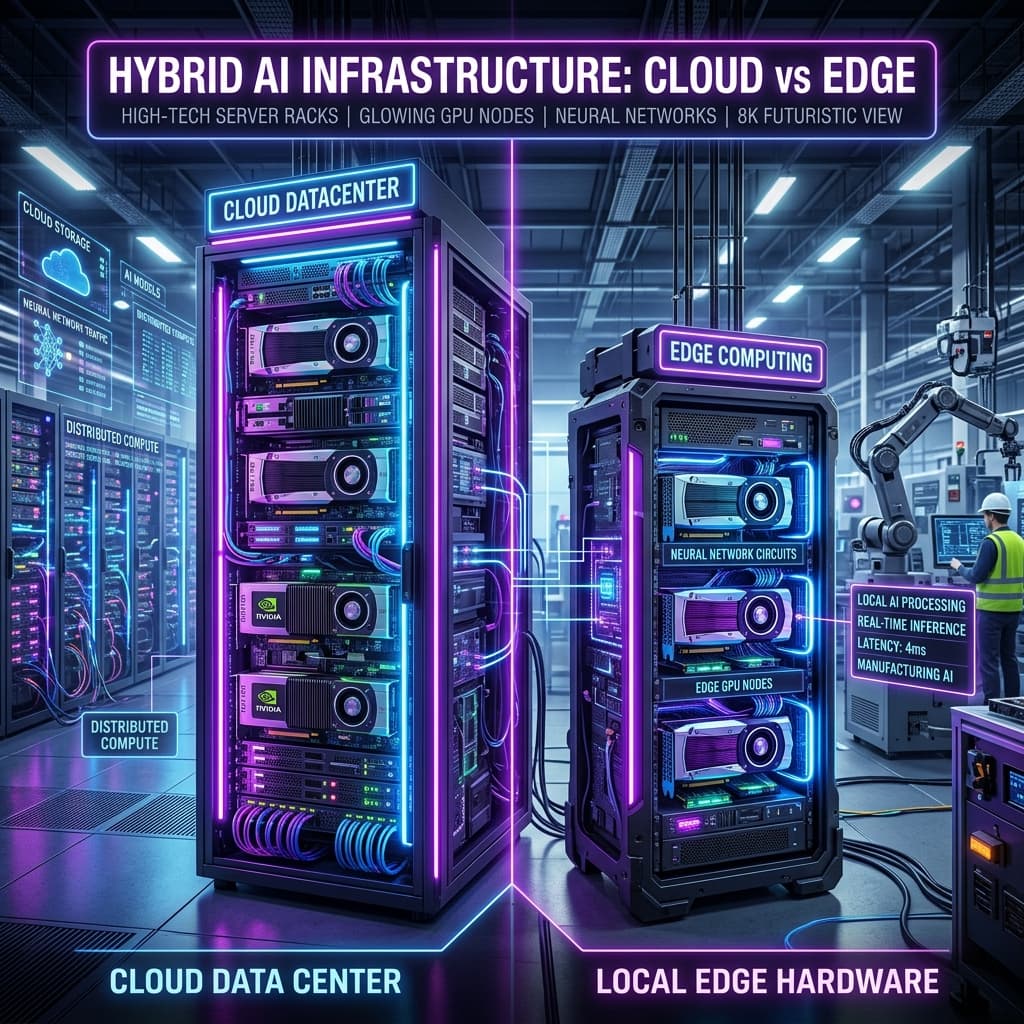
When designing an enterprise physical AI infrastructure, organizations must evaluate the trade-offs between centralized cloud AI, local edge AI, and hybrid management architectures.
| Architectural Dimension | Centralized Cloud AI Architecture | Local / On-Device AI Architecture | Hybrid Management Architecture (DIHUAVA Standard) |
|---|---|---|---|
| Data Processing Location | External Cloud Data Center | Local Edge GPU / NPU Workstation | 100% Local Inference + Optional Cloud Management Sync |
| Internet Dependency | Mandatory Continuous WAN Connection | Zero WAN Dependency (Air-Gapped) | Operates 100% offline by default; optional WAN for dashboard updates |
| Data Privacy & Leakage | Transmits audio/video over public WAN | Zero data leakage; 100% on-premise containment | Local processing preserves total data privacy and air-gapped security |
| Operational Resilience | Complete system failure during internet outage | 100% operational uptime during network outages | Uninterrupted offline interaction with remote background updates |
| Content Updates | Real-time cloud API stream | Manual physical updates (USB / Local LAN) | Centralized DIHUAVA dashboard remote content deployment |
| Hardware Form Factor | Low-spec thin client + WAN connection | Industrial Edge AI Workstation | Built-in Industrial Edge AI Workstation |
- Canonical System Standard: *"DIHUAVA runs 100% offline on-device by default, with optional cloud-management configurations available."*
How DIHUAVA Fits Into Physical AI Deployments
To understand how software and hardware interact across an enterprise fleet, organizations must recognize the clear separation between the underlying AI engine and the physical display form factor:
- HS Global AI: The enterprise technology provider delivering end-to-end hardware-software physical AI solutions.
- [DIHUAVA AI Platform](/products/ai-digital-human): The core AI software engine responsible for real-time talking avatar rendering, neural speech synthesis (TTS), automatic speech recognition (ASR), local RAG document intelligence, and multi-location management.
- AI Digital Humans: The embodied 3D virtual avatars engineered with customized visual appearances, corporate uniforms, brand logos, and specific behavioral personalities.
- Physical AI Display Environments: The specialized physical display hardware hosting the avatar:
- [3D Hologram Boxes](/products/holographic-display): Volumetric 3D display enclosures creating the visual perception of a physical human presence.
- [Spatial Displays](/products/spatial-display): Ultra-slim 3D screens providing glasses-free depth perception for interactive product exploration.
- Interactive AI Kiosks: Heavy-duty floor-standing units designed for high-traffic public reception, wayfinding, and customer service.
Explore the complete line of [AI hardware and software products](/products) or download architectural specifications in our [download center](/contact/download-center).
Multi-Location Deployment Model
An enterprise fleet deployment relies on a multi-tier governance model. This conceptual architecture separates centralized brand rules from localized operational execution:
``` Central Enterprise Governance ├── Brand Guidelines & Avatar Personality Rules ├── Core Compliance Guardrails & System Security Settings └── Global Knowledge Base & Base Document Ingestion │ ▼ DIHUAVA Central Management Dashboard ├── Location Node Registry & Device Health Oversight ├── Regional Content Packaging & Language Profile Assignment └── Remote Schedule Pushes & Content Deployment │ ▼ Location-Specific Configuration (Store / Branch / Facility) ├── Localized Product Catalog & Regional Service Schedules ├── Branch-Specific FAQ Indexing & Promotional Assets └── Air-Gapped Local Edge AI Hardware Engine │ ▼ Physical Display Output (Hologram Box / Spatial Display / Kiosk) ├── Directional Microphone Array & Optical Sensor Input ├── Real-Time Local AI Inference & 3D Avatar Rendering └── Instant Low-Latency Voice & Visual Customer Interaction ```
This model ensures that while central administrators control global brand rules and base knowledge, local branch configurations tailor interactions to specific regional requirements.
Managing Different Locations & Audiences
Enterprise organizations operate across diverse physical environments. Content and avatar behaviors must adapt to the unique requirements of each venue:
Retail Store Chains A national fashion retailer can deploy AI Digital Humans across multiple locations. While the avatar visual appearance and corporate uniform remain standardized, the local knowledge base in a flagship downtown store features luxury items, whereas a suburban outlet location highlights promotional clearance items and family reward programs. Learn more about **[retail store chains deployment strategies](/industries/retail)**.
Banking Branch Networks Across a network of bank branches, an AI Digital Human avatar deployed inside a 3D Hologram Box in a VIP wealth management lounge assists high-net-worth clients with investment product summaries. Meanwhile, the same avatar persona deployed on interactive kiosks in retail branches handles everyday queue management, card activation guidance, and service directions. Explore **[banking branch network solutions](/industries/banking)**.
Hospitality & Hotel Networks Hotel groups deploying interactive Spatial Displays across urban luxury hotels and airport transit locations can customize local recommendations. The urban avatar highlights fine dining and cultural tours, while the transit hotel avatar focuses on flight status lookups, express check-in guidance, and shuttle schedules. Discover **[hospitality & tourism AI experiences](/industries/tourism)**.
Healthcare Facilities & Medical Centers Across hospital networks, AI Digital Humans deployed at main reception desks assist patients with department wayfinding, outpatient clinic intake guidance, and visiting hour information. All patient interactions process locally on-device, preserving patient health data privacy. Review **[healthcare facilities patient guidance](/industries/healthcare)**.
Higher Education & Campus Networks Across university campuses and educational institutions, AI Digital Humans assist students and visitors with campus navigation, department directory lookups, event schedules, and administrative admissions guidance. Explore **[smart education AI deployments](/industries/education)**.
Multilingual AI Across Multiple Locations
Operating physical AI displays across international or demographically diverse regions requires robust, offline multilingual capabilities:
- 29+ Global Languages: DIHUAVA processes native offline speech ASR, translation, and neural speech synthesis across English, Spanish, Mandarin, Arabic, Japanese, French, German, Russian, and 21+ additional global languages.
- 7 Specialized Indian Languages: Native edge AI speech processing across Hindi, Tamil, Telugu, Kannada, Bengali, Marathi, and Gujarati running 100% on-device.
Because speech recognition, translation, and voice synthesis execute locally on the built-in edge GPU workstation, multi-location deployments eliminate per-interaction cloud translation API fees and prevent language processing latency during customer interactions.
Privacy & On-Device AI at Scale
Data privacy is a foundational requirement for physical AI installations operating in public and enterprise spaces.
- Air-Gapped Security Architecture: DIHUAVA processes 100% of visitor audio, camera sensor feeds, and document queries locally on the physical device.
- Zero Cloud Data Leakage: No raw customer speech recordings, facial biometric data, or confidential query logs are transmitted to third-party public cloud endpoints.
- 100% Patient & Client Privacy: In healthcare and financial settings, local on-device execution ensures complete compliance with enterprise data governance and internal privacy standards.
When cloud connectivity is desired for remote content deployment or system health diagnostics, management traffic is handled via encrypted management protocols while keeping interaction data strictly contained within local edge hardware.
Operational Considerations for Enterprise Deployment
Successfully operating a multi-unit physical AI display fleet requires evaluating key operational domain areas:
1. Hardware Placement & Acoustics: Positioning Hologram Boxes and Spatial Displays in areas with controlled ambient lighting and manageable acoustic noise levels to ensure optimal optical clarity and microphone pickup. 2. Network Security Infrastructure: Configuring local firewalls and dedicated VLANs for devices utilizing optional cloud-management configurations. 3. Edge GPU Thermal & Power Delivery: Ensuring display enclosures provide adequate airflow, surge protection, and thermal dissipation for industrial AI computing hardware. 4. Content Governance & Version Control: Establishing authorization workflows for approving local document updates prior to pushing content to production display endpoints. 5. Staff Training & Local Escalation: Training local branch staff on basic physical power controls, daily display inspection, and escalating complex inquiries from the AI avatar to human staff.
Example Enterprise Deployment Scenarios
*(Note: The following scenarios are illustrative architectural models designed for enterprise planning purposes).*
Scenario A: Retail Chain Store Rollout (Illustrative 50-Store Model) - **Objective**: Standardize seasonal product promotions and interactive catalog discovery across a network of 50 retail locations. - **Architecture**: Central marketing uploads updated product PDFs and promo video assets to the central DIHUAVA dashboard. The dashboard pushes content packages remotely to all 50 edge workstations overnight. - **Local Result**: Avatars across all 50 stores launch synchronized promotional messaging at opening time, processing customer queries 100% offline.
Scenario B: Regional Banking Network Rollout (Illustrative 20-Branch Model) - **Objective**: Deliver multilingual customer onboarding and loan product explanations across 20 regional bank branches. - **Architecture**: Air-gapped Hologram Boxes running 100% offline local RAG document intelligence. Local branch staff update regional interest rate sheets via secure local network updates. - **Local Result**: Complete customer privacy with zero cloud data transmission, providing low-latency financial service guidance in 7 specialized Indian languages.
AI Digital Human Fleet vs Traditional Digital Signage
Replacing or augmenting traditional digital signage with conversational AI Digital Human fleets transforms passive visual displays into interactive engagement hubs.
| Functional Feature | Traditional Digital Signage Fleet | AI Digital Human Fleet (DIHUAVA) |
|---|---|---|
| Media Format | Passive looping video / static graphics | Interactive 3D Digital Human Avatar |
| Engagement Model | One-way visual broadcast | Real-time two-way natural voice conversation |
| Language Capability | Fixed subtitles or pre-shot video clips | Instant dynamic switching across 29+ languages |
| Knowledge Depth | Limited to visual text on screen | Ingests complex PDFs, manuals, & catalogs via local RAG |
| Customer Guidance | Static floor maps / directional arrows | Interactive visual and vocal step-by-step guidance |
| Data Privacy Model | Non-interactive visual display | 100% offline edge processing with zero cloud data leakage |
| Remote Management | CMS video file push | Centralized DIHUAVA dashboard for content & persona sync |
Enterprise Deployment Checklist
Enterprise project teams preparing to roll out multi-location AI Digital Humans can follow this step-by-step deployment checklist:
- [ ] Define Location Matrix: Document all target physical sites, branch types, and audience demographics.
- [ ] Select Hardware Display Form Factors: Choose between 3D Hologram Boxes, Spatial Displays, or interactive kiosks based on venue space.
- [ ] Configure AI Avatar Persona: Establish visual appearance, corporate attire, brand logos, voice cadence, and personality guardrails.
- [ ] Ingest Local Knowledge: Upload enterprise PDFs, product catalogs, FAQs, and service manuals into the local RAG engine.
- [ ] Configure Language Registry: Select required language models from the 29+ global and 7 specialized Indian language options.
- [ ] Perform Site Environment Audit: Verify physical mounting space, power stability, lighting conditions, and ambient noise levels.
- [ ] Establish Privacy Architecture: Confirm air-gapped standalone mode or hybrid cloud-management configuration.
- [ ] Execute Pilot Evaluation (POC): Deploy 1–2 test units for a 2–4 week pilot validation prior to full rollout.
- [ ] Train Branch Operations Staff: Educate local branch teams on daily operational checks and customer escalation protocols.
- [ ] Deploy Central Management: Initialize the central DIHUAVA dashboard for remote content pushes and system health oversight.
- [ ] Launch & Monitor: Execute phased fleet rollout and monitor conversation topics and system health status.
Frequently Asked Questions (FAQ)
What is AI Digital Human fleet management? AI Digital Human fleet management is the centralized governance, content configuration, persona alignment, and health monitoring of multiple physical AI Digital Human displays deployed across separate geographic locations.
Can AI Digital Humans be deployed across multiple locations? Yes. DIHUAVA features centralized multi-location management, allowing administrators to control, update, and monitor multiple hologram and display units across global branches from a central dashboard.
Does DIHUAVA require continuous cloud connectivity? No. DIHUAVA runs 100% offline on-device by default, with optional cloud-management configurations available. Core conversational AI, neural speech synthesis, and document RAG operate completely offline on local hardware.
Can different locations use different content and product catalogs? Yes. Content and AI knowledge bases can be customized per location or pushed remotely across all deployed devices through the central DIHUAVA dashboard without disrupting active operations.
Can AI Digital Humans support multiple languages across different branches? Yes. HS Global AI supports 29+ global languages including 7 specialized Indian languages (Hindi, Tamil, Telugu, Kannada, Bengali, Marathi, Gujarati) running 100% on-device.
Can DIHUAVA work with Hologram Boxes? Yes. DIHUAVA integrates directly with 3D Holographic Display hardware powered by built-in industrial edge AI workstations.
Can DIHUAVA work with Spatial Displays? Yes. DIHUAVA is fully compatible with 3D Spatial Displays, delivering glasses-free 3D avatar rendering and interactive product visualization.
What should enterprises consider before deploying AI Digital Humans at scale? Enterprises should evaluate display form factors, venue acoustics and lighting, document knowledge bases, language requirements, privacy constraints (air-gapped vs hybrid), and central governance workflows.
Ready to Scale Your Physical AI Experience?
Discover how DIHUAVA AI Digital Humans, 3D Hologram Boxes, and Spatial Displays can transform your multi-location customer experiences.
Ready to Transform Your Enterprise Operations?
Join industry leaders deploying DIHUAVA AI Digital Humans for 24/7 autonomous customer reception, knowledge access, and interactive retail.