
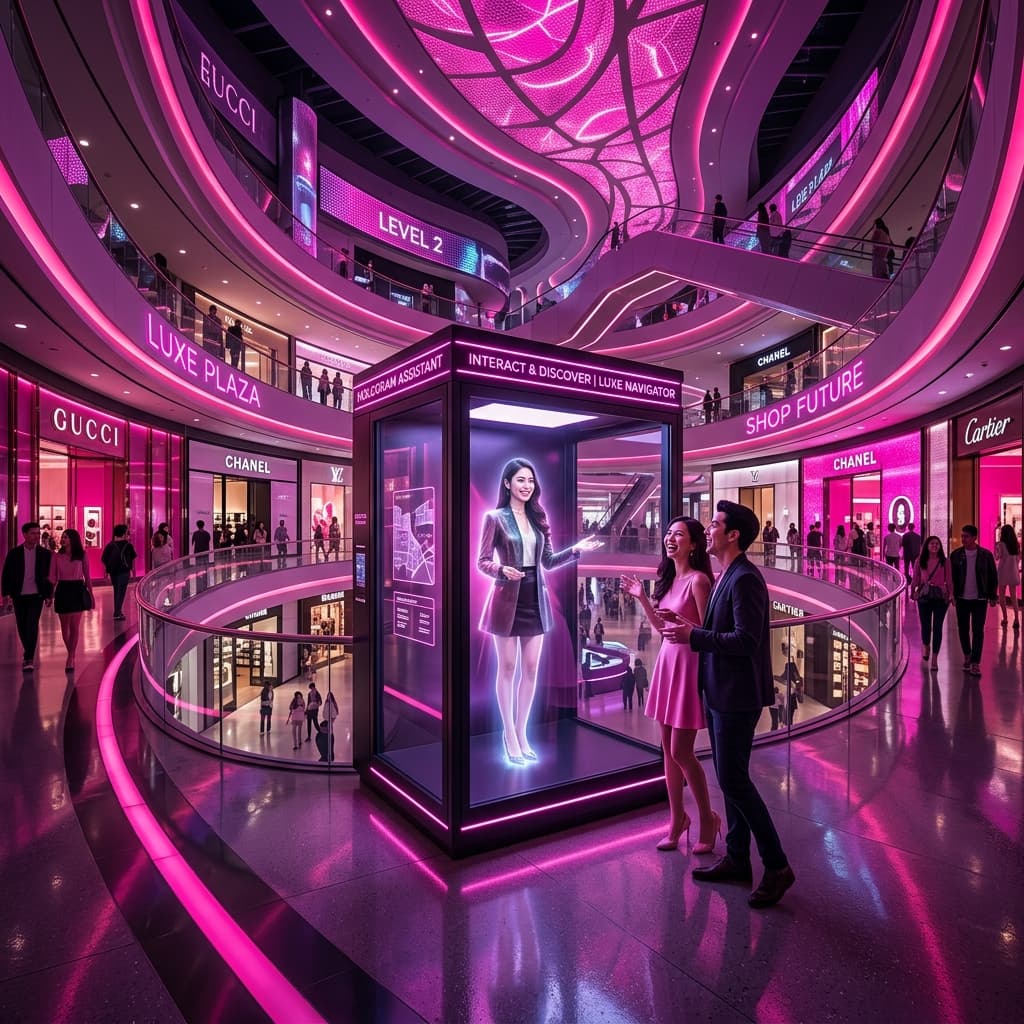
- In-Store Foot-Traffic Engagement: Digital human docents greet shoppers and answer product inquiries on the sales floor.
- Spatial Product Presentation: Integrates with 3D Hologram Boxes and Spatial Displays for high-definition visual showcases.
- Interactive AI Product Catalog: Recommends relevant items and guides shoppers through inventory details in real time.
- Target Benchmark Impact: Designed to capture up to 3x higher visitor attention as an illustrative customer engagement model.
Introduction
The retail industry is undergoing a major technological transformation with the adoption of AI in retail. Businesses are now using AI-powered solutions to enhance customer engagement, improve sales, and deliver personalized in-store experiences.
One of the most impactful innovations leading this change is the use of DIHUAVA AI Digital Humans as intelligent sales assistants. DIHUAVA runs 100% offline on-device by default, with optional cloud-management configurations available.
Challenges in Retail Today
Retail businesses face several critical operational challenges:
- High customer expectations for immediate assistance and product information
- Limited staff availability during peak shopping hours
- Language barriers when serving international tourists and diverse shoppers
- Inconsistent customer experience across different store locations
This is where retail automation powered by AI plays a crucial role.
What is AI in Retail?
AI in retail refers to the use of artificial intelligence to automate processes, analyze customer behavior, and improve physical and digital shopping experiences in retail & shopping interactive environments.
With solutions like AI sales assistants and [AI Hologram Boxes](/products/holographic-display), retailers can interact with customers in real time and provide personalized recommendations via the AI Product Catalog.
Role of Digital Human Avatars in Retail
Digital human avatars act as customer engagement AI tools that:
- Greet customers at store entrances and high-traffic aisles
- Answer product queries regarding specs, warranties, and store policies
- Recommend products based on customer preferences and context
- Display product visuals in high-definition 3D spatial graphics on Spatial Displays
- Assist in purchase decisions and guide shoppers through promotions
Traditional Touchscreen vs AI Digital Human Sales Assistant
| Feature | Traditional Touchscreen Poster | AI Digital Human Assistant |
|---|---|---|
| Interaction | Manual touch tapping | Voice + Visual gestures |
| Engagement | Static & passive | High interactive attraction |
| Personalization | Generic fixed catalog | Adaptive AI recommendations |
| Multilingual | Limited language options | 29+ global languages in real time |
Smart Retail Technology in Action
Modern smart retail technology combines multiple advanced systems:
1. AI recommendation engines to analyze shopper intent 2. Voice interaction for hands-free natural conversation 3. Visual displays (Hologram Boxes, spatial glass, smart kiosks) 4. Product catalog integration connected directly to store inventory
This creates a seamless, interactive, and memorable shopping experience.
Real-World Use Cases
Shopping Malls Interactive guides, store directory wayfinding, and promotional engagement.
Retail Stores AI-powered product recommendations, inventory checking, and queue relief.
Jewelry & Luxury Outlets Personalized product suggestions, 3D spatial displays, and VIP customer greeting. Retailers can also integrate **[Virtual Try-On technology](/blog/what-is-virtual-try-on-technology)** to showcase high-definition digital watch and accessory models.
Benefits of AI in Retail: Target Benchmarks
- Improved customer engagement (Target Benchmark): Designed to capture up to 3x higher visitor attention.
- Increased sales conversions: Guides shoppers smoothly to checkout.
- Reduced manpower dependency: Automates routine informational inquiries.
- Multilingual support: Serves diverse international shoppers effortlessly across 29+ global languages engine.
- Consistent brand experience: Delivers uniform messaging across all store branches. You can explore hardware datasheets in our [download center](/contact/download-center).
Frequently Asked Questions (FAQ) About AI in Retail
How do AI Digital Human avatars increase retail customer engagement? By replacing passive flat signs with 3D holographic avatars that greet shoppers face-to-face, answer questions in natural spoken voice, and display interactive product models on demand.
Can retail AI avatars display 3D product models in real time? Yes. Integrated with glasses-free **[Spatial Displays](/products/spatial-display)** and **[3D Hologram Boxes](/products/holographic-display)**, avatars present high-definition 3D product models that shoppers can view from multiple angles.
Do retail AI display kiosks operate offline during internet outages? Yes. DIHUAVA runs 100% offline on-device by default, with optional cloud-management configurations available, guaranteeing continuous uptime on the store sales floor.
Conclusion AI in retail is redefining how businesses interact with customers. With technologies like digital human avatars, retailers can deliver smarter, faster, and significantly more engaging customer experiences.
Transform Your Retail Experience
Ready to bring AI digital human avatars to your retail stores or shopping centers?